

AT3-420-24L-FL AC Current Transducer, Solid-core, 4-20mA Output Range, 0-375, 0-500, & 0-750A Input Range, 12-40VDC Power Supply
Product details
| Management number | 220369033 | Release Date | 2026/05/03 | List Price | $104.92 | Model Number | 220369033 | ||
|---|---|---|---|---|---|---|---|---|---|
| Category | |||||||||
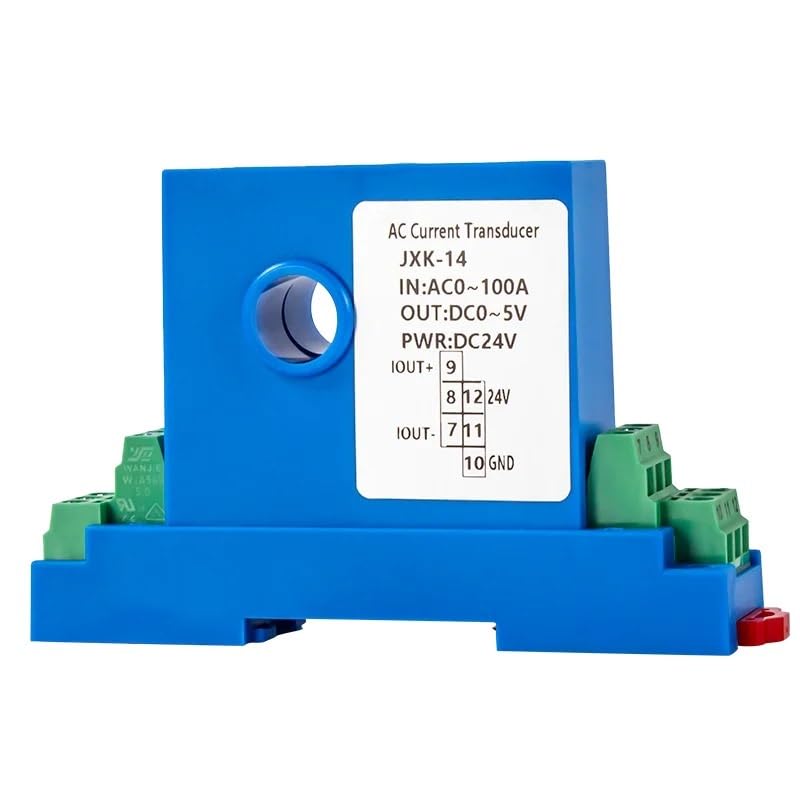
This NK Technologies AT series current transducer combines a solid-core current transformer and signal conditioner, and is suitable for use in industrial automation systems. The transducer provides average root-mean-square (RMS) measurement for sinusoidal alternating current waveforms, with an accuracy of 1.0% full scale (FS) and a response time of 600 ms (10-90% step change). The large aperture accommodates large diameter conductors or cables and user-selectable input current ranges reduce inventory needed. This current transducer is Underwriters Laboratories (UL) listed and Conformité Européenne (CE) certified for quality assurance. It is suitable for monitoring linear, constant-speed alternating current (AC) loads that produce sinusoidal waveforms.SpecificationsSignal Output4-20 mADCFrequency Range50-60 HzInsulation Voltage600 VACOperating Temperature-20 C to 50 CCurrent transducers are used to detect electrical current flowing in a wire or cable, and to generate an electrical signal proportional to the current for measurement or control. The transducer consists of an electrical winding, a magnetic core, and a signal conditioner. When current flows through a wire, the transducer winding generates a current, which produces a magnetic field in the core, which then creates a proportional current or voltage output signal. Current transducers are used in industrial automation systems for monitoring, alarming, and equipment control.NK Technologies manufactures electrical sensors. The company, founded in 1982 and headquartered in San Jose, CA, meets International Organization for Standardization (ISO) standards 9001 and 14001.
- Average RMS measurement for sinusoidal alternating current waveforms
- 1.0% FS accuracy
- Response time of 600 ms (10-90% step change)
- Large aperture accommodates large diameter conductors or cables
- UL Listed and CE certified for quality assurance
| Item Weight | 1.3 ounces |
|---|---|
| Manufacturer | NK Technologies |
| Item model number | 4-20mA |
| Product Dimensions | 7.75 x 5 x 3.25 inches |
Bestseller ranking
Campaigns

Customers who viewed this product also viewed
Current


Correction of product information
If you notice any omissions or errors in the product information on this page, please use the correction request form below.
Correction Request Form